
Pickleball court dimensions are simple once you see the whole court at once. A regulation court is 20 feet wide and 44 feet long, the same size for singles and doubles. Looking into your own court, or just trying to read the lines on a public court? Let us walk through it together, with official numbers first.
Official Pickleball Court Dimensions
Here is the official layout, in feet first with metres in brackets for readers in Canada. Measurements are taken to the outside edge of the perimeter lines and the non-volley zone lines.
Part of the court | Official size |
|---|---|
Court, singles and doubles | 20 feet (6.10 m) wide by 44 feet (13.41 m) long |
Minimum playing surface | 30 feet (9.14 m) wide by 60 feet (18.29 m) long |
New construction and tournament surface | 34 feet (10.36 m) wide by 64 feet (19.5 m) long |
Non-volley zone, each side | 7 feet (2.13 m) deep by 20 feet wide |
Service court, each box | 10 feet (3.05 m) wide by 15 feet (4.57 m) deep |
Line width | 2 inches (5.08 cm) |
Net height, sidelines | 36 inches (91.44 cm) |
Net height, centre | 34 inches (86.36 cm) |
Net posts | 22 feet (6.71 m) apart, inside to inside |
Net length, minimum | 21 feet 9 inches (6.63 m) |
For the full rule text, see the Essential Pickleball Rules Summary.
The Standard Court: Quick Blueprint
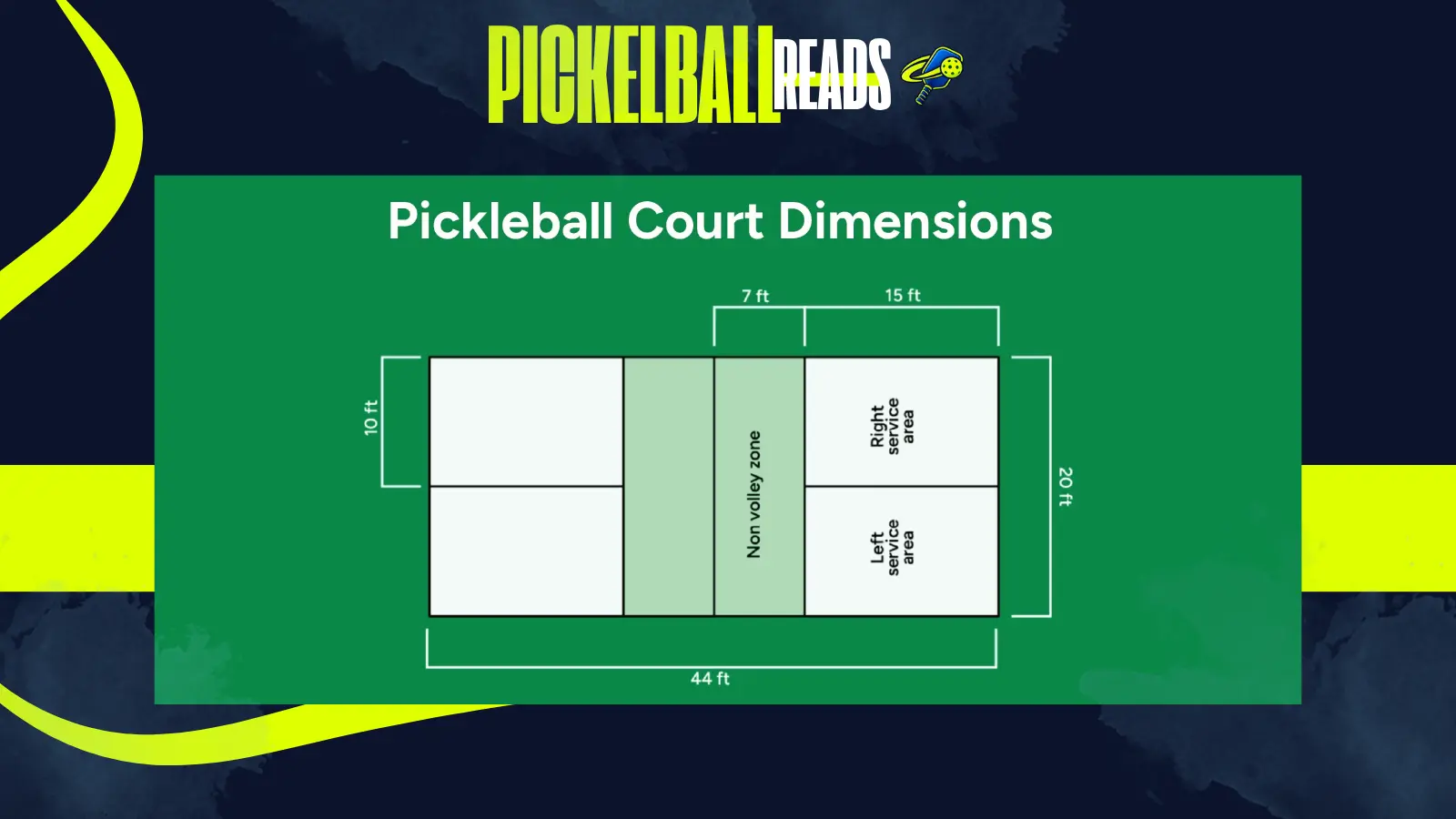
A net splits the court into two equal halves of 22 feet each. On each side, the kitchen extends 7 feet back from the net, and the area behind it is divided by the centerline into two service courts. That layout never changes when you switch from singles to doubles. The court area itself is 880 square feet.
Court Markings and Layout
Baselines and Sidelines
Baselines sit parallel to the net at each end of the court. Each baseline is 20 feet long and 22 feet from the net, which is 15 feet from the kitchen line. Sidelines run the full length of the court, 44 feet long and 20 feet apart. All lines should be 2 inches wide and the same colour, clearly contrasting with the playing surface. A ball that lands on a line is in, with one exception on the serve, below.
Service Courts
Behind the kitchen on each side, the centerline divides the court into a right service court and a left service court. Each box is 10 feet wide and 15 feet deep, bounded by its baseline, its sideline, and the centerline. The serve must go diagonally to the opposite service court and must clear the kitchen. A serve on the kitchen line is short and a fault. A serve on the baseline, sideline, or centerline is in.
Additional Markings
There is no centerline in the kitchen. The centerline runs from the kitchen line to the baseline on each side, and it stops at the kitchen line. That is the complete standard layout: baselines, sidelines, kitchen lines, and centerlines. On a shared court, pick out which lines belong to pickleball before the first serve.
The Kitchen: Why Seven Feet Changes Everything
If one measurement defines pickleball, it is the seven foot kitchen. You cannot volley, meaning hit a ball out of the air, while standing in the kitchen or touching its line. You can step in to play a ball after it bounces, but you must get both feet back outside before you volley again. Momentum into the kitchen after a volley is also a fault, even if the ball is already dead. That rule keeps the game from turning into a smash contest at the net.
For the full kitchen rule, see what is the kitchen in pickleball.
Net Height and Placement
The net stands 36 inches high at the sidelines and 34 inches at the centre, with a tolerance of plus or minus 0.25 inch at each point. Net posts should be 22 feet apart from inside to inside, about 1 foot outside each sideline, and no more than 3 inches in diameter. The net should be at least 21 feet 9 inches long and at least 30 inches deep, made of any mesh material that will not let a ball pass through it. A centre strap may be used to hold the centre height. Do not use a badminton net for a formal game: it is 5 feet high, far above the pickleball specification.
Space Around the Court
The painted court is only part of the space you need. The minimum playing surface is 30 feet wide by 60 feet long, giving 5 feet beside each sideline and 8 feet behind each baseline. For new construction and for tournament play, the rulebook recommendation is larger: 34 feet wide by 64 feet long. For a stadium court, it is 50 feet wide by 80 feet long. A larger surface is not a different court, the lines stay exactly the same. Wheelchair play uses the same court lines, with a larger recommended surface of 44 feet wide by 74 feet long.
How It Compares
A doubles tennis court is 36 feet wide by 78 feet long, or 2,808 square feet. A pickleball court, at 880 square feet, is about 31 percent of that area, often described as roughly a third. That compact size is a large part of why the game feels welcoming: less ground to cover and longer rallies. A doubles badminton court shares the same 20 by 44 foot footprint as pickleball. The differences are the net height and the kitchen, which badminton does not have.
How the Numbers Shape Your Strategy
This part is strategy, not a rule. The baseline sits 22 feet from the net, while the kitchen line sits just 7 feet away. Your goal on most points is to move from the back of the court to the kitchen line, because the team that controls that space usually controls the point. That is the logic behind the third shot drop, a soft shot from the baseline that lands in the opponent kitchen and gives your team time to advance.
Setting Up Your Own Court at Home
Mark out a 20 by 44 foot rectangle with tape or chalk, measure 7 feet from the net for the kitchen lines, and set the net to 36 inches at the sides and 34 inches in the middle. Leave as much space as you can, ideally the 30 by 60 foot minimum. Indoor and outdoor courts use the same dimensions. USA Pickleball construction guidance says outdoor courts should be oriented north to south, to avoid sun in players eyes. That is guidance, not a rulebook rule.
Quick Checklist
Use this checklist before you build or mark a court, and treat the building items as choices to check with a builder, not as official specifications:
Space: at least 30 feet by 60 feet, or 34 feet by 64 feet for new construction?
Lines: measured to the outside edge, with 2 inch lines in a contrasting colour?
Net: 36 inches at the sidelines and 34 inches at the centre, posts 22 feet apart?
Orientation: if outdoors, can the court run north to south?
Surface, fencing, and lighting: what suits your site and budget? Costs vary widely, so get a local quote.
Why Correct Dimensions Matter
Almost all players learn on standard courts, so a nonstandard court throws off timing and movement, and it can put players at risk when run off is too short. A regulation court also keeps play fair, with no host advantage from a short baseline or a narrow sideline. In Canada, sanctioned play follows the same 2026 Official Rulebook, posted by Pickleball Canada in English and French. There is no separate Canadian court size. For the Canadian rulebook text, see the Pickleball Canada 2026 Official Rulebook.
Frequently Asked Questions
How big is a pickleball court?
A pickleball court is 20 feet wide and 44 feet long, the same size for singles and doubles. The minimum playing surface around it is 30 feet wide by 60 feet long.
How tall is a pickleball net?
A pickleball net is 36 inches tall at the sidelines and 34 inches tall at the centre. The centre strap may be used to hold the centre height.
How big is the kitchen in pickleball?
The kitchen, or non-volley zone, extends 7 feet from the net on each side and spans the full 20 foot width of the court. You cannot volley while standing in it or touching its line.
Can you fit a pickleball court on a tennis court?
Yes, by size alone, one pickleball court fits inside a tennis court footprint. How many courts fit on a given tennis court in practice depends on layout and run off, so check the full playing surface, not just the painted lines.
Do singles and doubles use the same court size?
Yes. The 2026 Official Rulebook specifies the same 20 by 44 foot court for both singles and doubles matches. Only the number of players, and therefore the coverage, changes.
Conclusion
Learn the core numbers and the rest falls into place: 20 by 44 feet for the court, 30 by 60 feet minimum for the playing surface, 7 feet for the kitchen, 10 by 15 feet for each service court, and 36 inches at the sides and 34 inches at the centre for the net. Build to those numbers, and your court will play the same as any standard court in the USA or Canada. For the full rules, see pickleball rules.