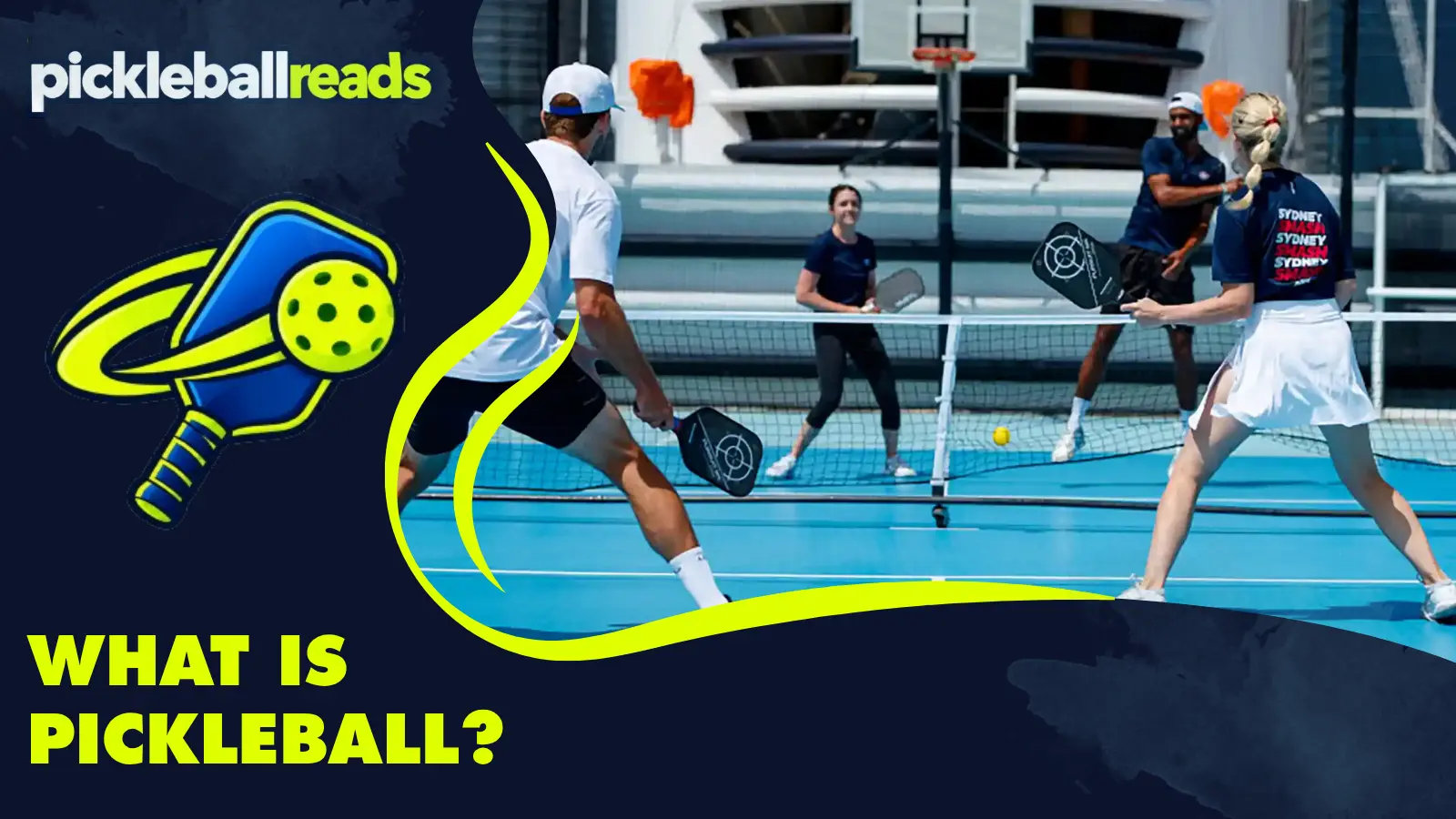
What is pickleball? It is a paddle sport that blends elements of tennis, badminton and table tennis, played on a badminton sized court with a lower net, a solid paddle and a perforated plastic ball. It can be played indoors or outdoors, as singles or doubles, and it is built around one simple idea: a game the whole family can learn quickly, enjoy right away and keep playing for years.
As the national governing body for the sport in the United States, USA Pickleball sets the official rules, approves equipment and sanctions tournaments. Its message is the best place to start: pickleball is easy to learn, hard to master, social by nature and open to players of all ages and abilities. This guide follows that same approach: the fundamentals, the history, the court and equipment, the rules in plain language, and how to get started in the USA and Canada.
What is pickleball? The basics in one minute
If you only read one section, read this one. These are the facts that define the game.
Fact | Detail |
|---|---|
Court size | 20 feet wide by 44 feet long, the same for singles and doubles |
Net height | 36 inches at the sidelines, 34 inches at the center |
The kitchen | A 7 foot non-volley zone on each side of the net |
Ball | Hard plastic ball with 26 to 40 circular holes |
Paddle | Solid, rigid paddle, with no strings |
Players | Singles (2 players) or doubles (4 players), doubles is most common |
Serve | Underhand, hit diagonally into the opposite service court |
Key rule | The two-bounce rule: the ball must bounce once on each side before volleys |
Scoring | Only the serving side scores in traditional play, games to 11, win by 2 |
First played | 1965, Bainbridge Island, Washington, USA |
A lasting legacy: the history of pickleball
Pickleball began in the summer of 1965 on Bainbridge Island, near Seattle, Washington. Joel Pritchard, a Washington state legislator who later served in the US Congress, returned home from golf one Saturday with his friend Bill Bell to find their families sitting around with nothing to do. The property had an old badminton court, but they could not find a full set of rackets or a shuttlecock. So they improvised: ping pong paddles, a perforated plastic ball, and a net lowered to 36 inches once they saw how well the ball bounced on the asphalt.
The following weekend, Barney McCallum was introduced to the game. Soon the three men created the first rules together, relying heavily on badminton and keeping one purpose in mind: a game the whole family could play together.
Year | Milestone |
|---|---|
1965 | The game is invented on Bainbridge Island, Washington |
1967 | The first permanent pickleball court is built in Seattle |
1972 | Pickle-Ball Inc. is formed to protect and promote the new sport |
1976 | The first known pickleball tournament is held in Tukwila, Washington |
1984 | The first official rulebook is published in the United States |
2019 | The first modern professional tours are formed in the USA |
2021 | Major League Pickleball launches with a team based format |
Why is it called pickleball?
Two stories follow this question everywhere, and only one has the order right. Joan Pritchard, Joel's wife, said the mix of sports reminded her of the pickle boat in crew, the boat made up of oarsmen left over from other crews. A game built from leftover parts of other sports had a fitting name.
The other story says the game was named after the family dog, Pickles, who liked to chase the ball. The Pritchard family account, and the position of USA Pickleball, is the other way around: the dog came along after the game was already named, and Pickles was named after the game. A reporter in the early 1970s decided the dog story was easier to relate to, which is why it spread so widely.
When did pickleball turn professional?
Pickleball grew quietly in community centers and schools for decades. That changed in 2019, when two professional tours were formed in the USA: the Association of Pickleball Players (APP), sanctioned by USA Pickleball, and the PPA Tour. Major League Pickleball (MLP) launched a coed team league in 2021, and the PPA Tour and MLP later merged under the United Pickleball Association in 2024.
The pickleball court and layout
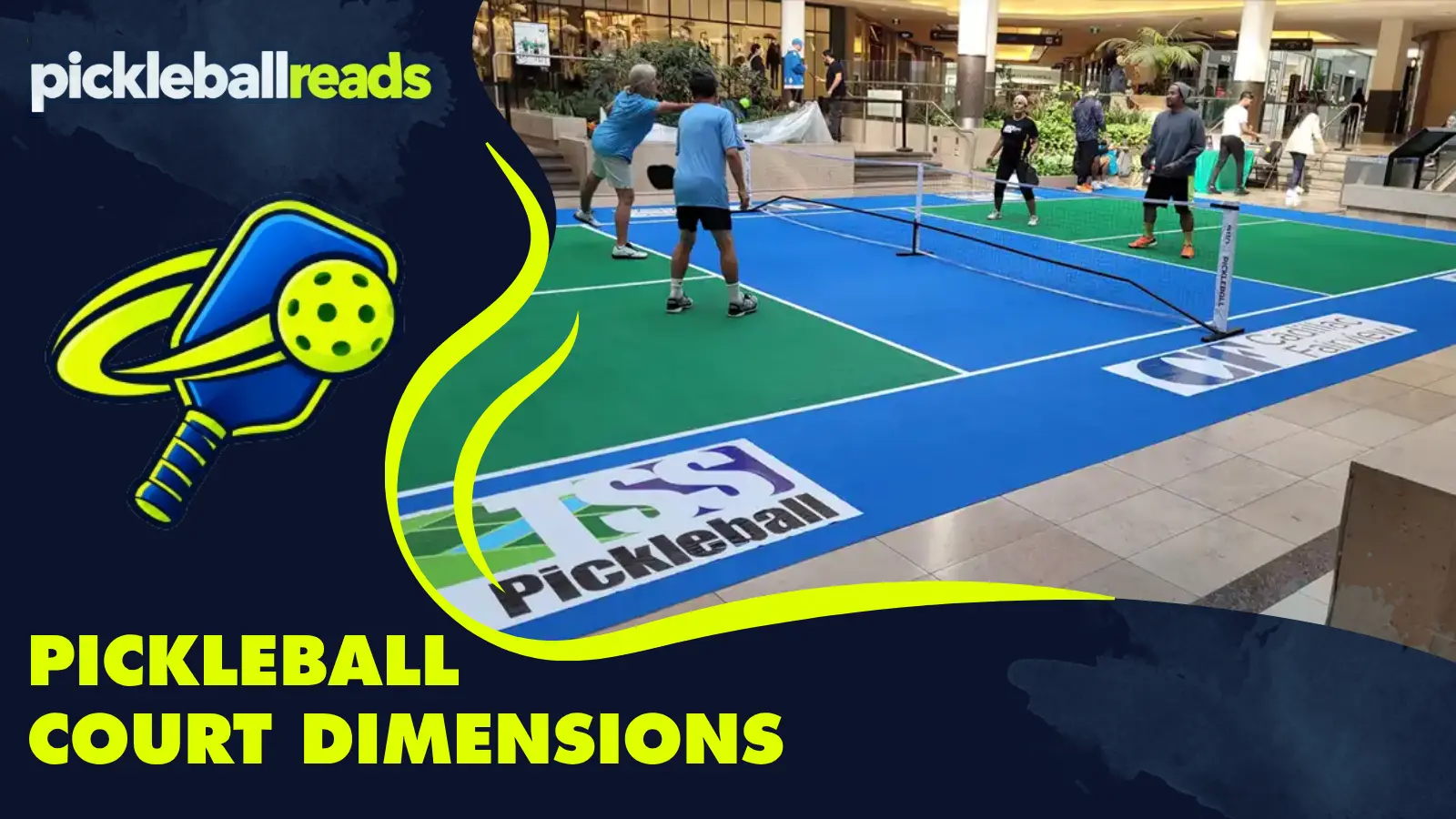
A pickleball court is a rectangle measuring 20 feet wide by 44 feet long, and the same court is used for singles and doubles. That makes it exactly the size of a doubles badminton court, and roughly a quarter of the playing area of a tennis court. The smaller space is deliberate: less ground to cover, and a game that rewards placement and patience more than raw running speed.
The net stands 36 inches high at the sidelines and 34 inches at the center. On each side of the net sits the most famous area in the sport, the non-volley zone, known everywhere as the kitchen. It extends 7 feet from the net across the full width of the court, and every line that bounds it counts as part of the zone. Behind the kitchen, a centerline splits each half into right and left service courts: the right court is used when the serving side has an even score, and the left when the score is odd.
If you are setting up a court of your own, the official minimum playing surface is 30 feet wide by 60 feet long, and 34 feet by 64 feet is recommended for new courts and tournament play. For every measurement, see our full guide to pickleball court dimensions.
Equipment: what you need to play
The shopping list is short. To start, you need a paddle, a ball and a court.
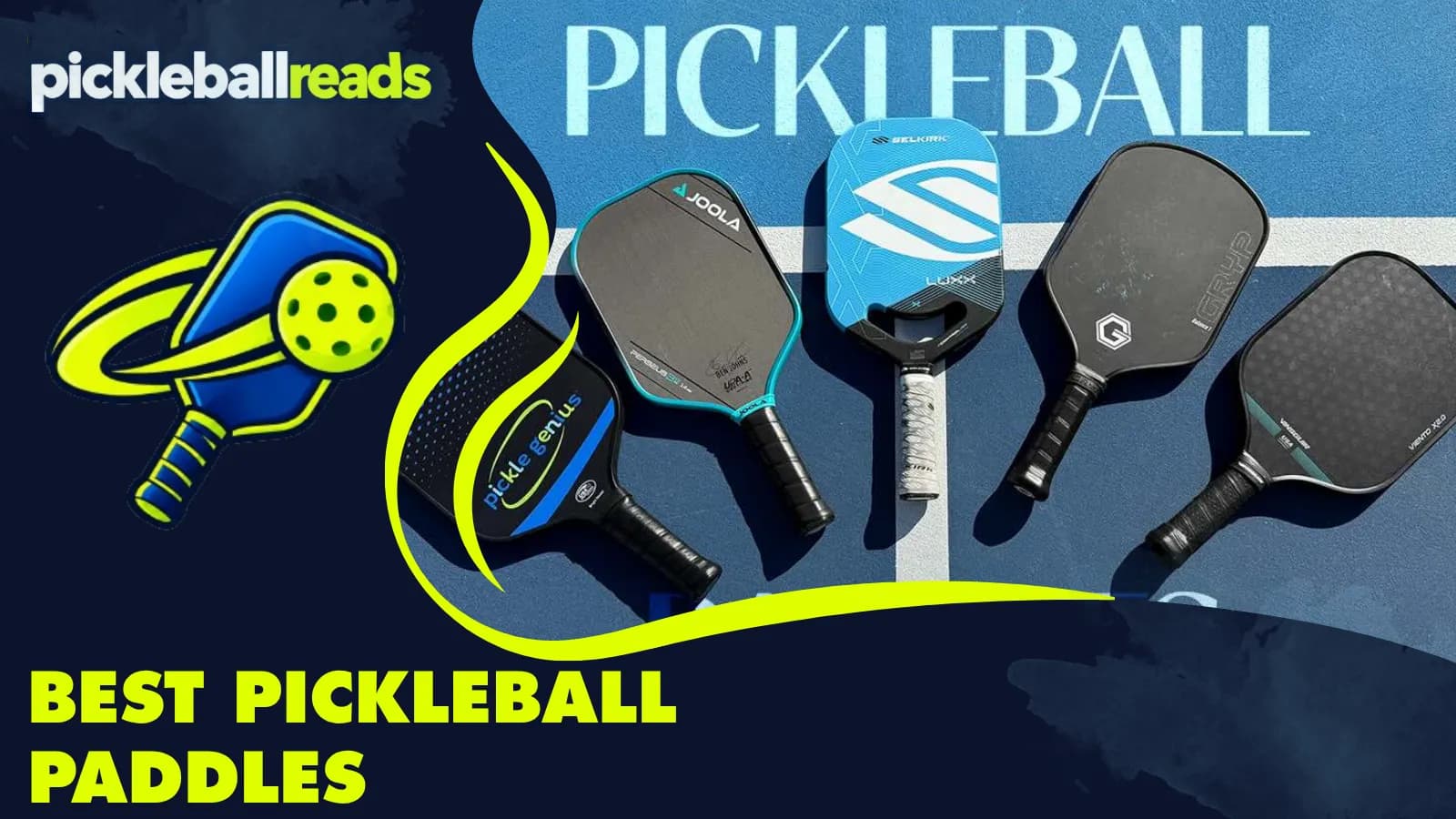
The paddle. A pickleball paddle is solid, with no strings, and must be made of a rigid, non-compressible material to be legal for tournament play. Its combined length and width cannot exceed 24 inches, and its length cannot exceed 17 inches. There is no official limit on paddle weight. Entry level paddles are usually wood, while higher level paddles use fiberglass, graphite and carbon fiber. Buying your first one? Start with the best pickleball paddles for beginners.
The ball. A pickleball is a hard, hollow plastic ball with between 26 and 40 circular holes, a diameter of about 2.87 to 2.97 inches and a weight of about 0.78 to 0.935 ounces. Indoor balls usually have larger holes and a softer feel for gym floors. Outdoor balls usually have smaller holes and harder plastic, so the wind moves them around less. For tournaments, paddles and balls must be on the official USA Pickleball approved equipment lists.
What to wear. Comfortable athletic clothing is enough for your first games. Two official details are worth knowing: your clothing should not closely match the color of the ball, and shoe soles must not mark or damage the court. Court shoes that support side to side movement are the smart choice.
Pickleball vs tennis: the key differences
Many new players arrive from tennis, so a simple comparison helps. Pickleball borrowed the net game of its older cousin, then shrank almost everything.
Feature | Pickleball | Tennis |
|---|---|---|
Court | 20 ft by 44 ft, same for singles and doubles | 78 ft long, 27 ft wide for singles, 36 ft for doubles |
Net | 36 in at the sidelines, 34 in at the center | 42 in at the posts, 36 in at the center |
Equipment | Solid paddle | Strung racket |
Ball | Plastic ball with holes, slower through the air | Felt covered ball |
Serve | Underhand only | Usually overhand |
Signature rule | Two-bounce rule and the kitchen | No equivalent zones |
Points | Games to 11, win by 2 | Games, sets and tiebreaks |
The practical result: rallies start quickly, the ball travels slower, and new players can hold a real rally in their first session.
How to play pickleball: gameplay essentials
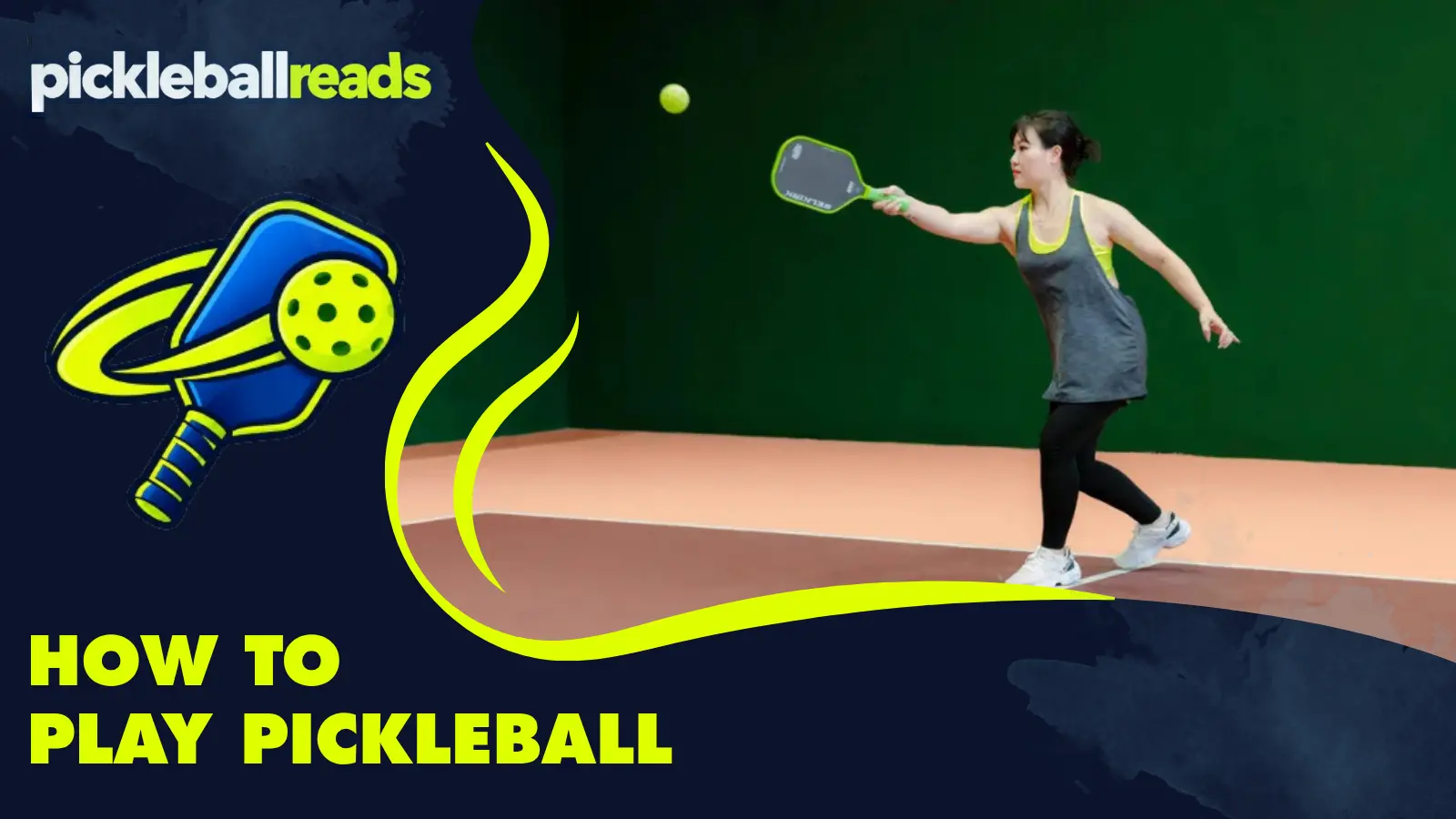
The full pickleball rules fill a rulebook, but a beginner game runs on seven simple rules. Learn these and you can walk onto any public court in the USA or Canada and join in.
Every rally begins with a serve. The server stands behind the baseline and hits the ball diagonally into the opposite service court.
The ball must bounce once on each side before anyone can volley. This is the two-bounce rule, explained in full below.
Each point continues until a fault. Play ends when a shot lands out, hits the net, bounces twice, or breaks another rule.
You cannot volley in the kitchen. A volley is a shot hit out of the air. If any part of your body is in the kitchen, or on its line, when you volley, it is a fault, and the same applies if your momentum carries you in after the shot.
You only win points on your serve. In traditional scoring, the receiving side can win the rally, but it wins the serve, not a point.
The correct score must be called before serving. In doubles the call has three numbers: your score, their score, and whether you are the first or second server.
The first team to 11 points wins, but you must win by 2. At 10-10, play continues until one side leads by two clear points.
For a step by step walkthrough, read how to play pickleball, the pillar guide this article supports.
Serving and scoring, in plain language
The serve is underhand by rule, not by custom. For a volley serve, where the ball is hit out of the air, three things must be true at contact: your arm is moving in an upward arc, the highest point of the paddle head is below your wrist, and contact is made below your waist. Keep at least one foot behind the baseline, with neither foot touching it, and do not spin the ball with your hand before you strike it. Since 2021, players can also use a drop serve: release the ball from one hand, let it bounce, and then hit it. The arc, wrist and waist limits do not apply to the drop serve, which makes it a friendly option for beginners.
The serve must clear the kitchen, including the kitchen line. A serve that touches the kitchen line is a fault, while a serve that lands on the baseline, sideline or centerline is good. A serve that clips the net and still lands in the correct service court is live and counts.
The server keeps serving, switching sides after every point won, until their side loses a rally. In doubles, the serve then passes to the partner, and when both partners have lost their serve, the ball sides out to the other team. At the very start there is one exception: the first team to serve in a game gets only one server, which is why every game begins with the score called as 0-0-2. In singles, the call has two numbers, and you serve from the right side when your score is even and from the left when it is odd.
The current rulebook also allows a provisional rally scoring format at some events, where each rally winner scores a point but game point must still be won on serve. Most recreational play uses the traditional format.
The two-bounce rule
This one rule does more than any other to make pickleball what it is. After the serve, the receiving side must let the ball bounce before returning it. The serving side must then let that return bounce before playing the next shot. Only after those two bounces can anyone volley.
Without it, the serving team could rush the net and attack every return from close range, and the game would belong to the tallest and strongest players. With it, both sides get a fair start to every rally, beginners get time to react, and the point develops into the patient kitchen battle that makes this sport so addictive.
The kitchen, explained simply
The kitchen is the 7 foot non-volley zone on each side of the net. You may stand in it, and you may play any ball that has bounced in it. What you may never do is volley a ball while your feet are in the zone or on its line, or let your follow through momentum carry you into it after a volley. It is the most called fault in beginner games, and the easiest to understand: it stops any player from camping at the net and smashing every ball straight down.
Faults and line calls, briefly
A fault is any rule violation that ends the rally. The beginner list is short: the ball lands out, the ball hits the net and does not cross, the ball bounces twice on one side, a volley is hit from the kitchen, a serve lands in the kitchen or outside the correct service court, or a serving foot fault occurs. Line calls follow a generous principle: a ball that touches any line is in, except a serve that lands on the kitchen line, and any ball that cannot clearly be called out is treated as in. When in doubt, the opponent gets the benefit of the doubt.
Singles and doubles
Doubles is the most popular way to play, and almost every beginner starts there. The court and the rules are the same as singles, with two differences. In doubles, each team gets two serves, one for each partner, except for the first serving turn of the game. In singles, there is one server at a time, the score call has two numbers, losing a rally means an immediate side out, and you will run much more. Singles is a wonderful workout, but doubles is the social heart of the game.
Types of shots in pickleball
You only need two shots on day one, the serve and the return. The rest arrive quickly.
Shot | What it is |
|---|---|
Drive | A hard, low shot hit with pace, usually from the baseline or midcourt |
Drop shot | A soft shot that arcs over the net and falls into the opponent's kitchen, best known as the third shot drop |
Dink | A soft, controlled shot played from near the kitchen line, landing in the opponent's kitchen |
Volley | Any shot hit out of the air before it bounces, legal only outside the kitchen |
Lob | A high shot sent over the heads of opponents at the net, toward the baseline |
Overhead | A shot hit above the head, usually to attack a lob, often called a smash |
Yes, you can hit a smash in pickleball, provided you are outside the kitchen when you volley. The dink surprises new players most: the softest shot in the sport also decides most points at higher levels, because it forces opponents to hit up from below the net, until someone leaves a ball high enough to attack.
Getting started: your first game
Getting started is genuinely simple, and it is the same in a small town in Ontario as it is in a big city park in Florida.
Find a court. Public parks, recreation centers and tennis centers adding pickleball lines are the most common places to begin. Many public courts are free, though some need a reservation or a small fee.
Borrow before you buy. Clubs, rec centers and the friend who invited you usually have spare paddles. Play two or three times before spending anything.
Join open play. Most venues run beginner friendly open play sessions where you rotate partners. Put your paddle in the queue, and you are in.
Play the courtesy game. Call the score out loud before you serve, give your opponent the benefit of the doubt on close line calls, and tap paddles at the end.
Take one lesson if you can. One hour on serving position, the two-bounce rule and kitchen footwork saves a month of bad habits.
Why is pickleball so popular?
The simple answer: it is easy to learn, fun in the first ten minutes, suitable for almost every age and fitness level, and social by design. The numbers behind that answer are just as striking.
In the United States, the Sports and Fitness Industry Association (SFIA) reported 19.8 million pickleball participants in 2024, an increase of 45.8% in one year and 311% over three years, making pickleball the fastest growing sport in the country for the fourth straight year. The growth is younger than its reputation suggests: the largest group of players is now aged 25 to 34, at 16.7% of all players, with players aged 65 and over next at 15.4%.
Canada is on the same path. Pickleball Canada estimated 1.54 million Canadian players in its 2025 survey, and about 1.80 million in its newer survey, with Ontario leading at roughly 702,000 players, followed by Quebec and British Columbia. When Canadians were asked why they play, 85% said enjoyment and fun, and 48% said health and fitness. Fun first, fitness second: that is the story of this sport in one line.
Health benefits of pickleball
Pickleball can be a real workout, and researchers have measured it. In a six week study at Western Colorado University, middle aged and older adults who played for an hour, three times a week, improved their cardiorespiratory fitness and cholesterol measures, and lowered their blood pressure. Their average heart rate during play was about 108 to 109 beats per minute, solid moderate intensity exercise, and they burned an average of about 354 calories per session. An earlier study in Medicine and Science in Sports and Exercise found that players burned 40% more calories in 30 minutes of pickleball than in 30 minutes of walking, and enjoyed it more.
Calorie burn depends on your weight and how hard you play. Figures cited by USA Pickleball put a 150 pound player at about 250 calories in 30 minutes of casual play and about 360 in aggressive play, while a 200 pound player reaches about 335 casual and 475 aggressive.
Pickleball injuries: the honest part
Easier on the body than many sports is not the same as risk free. Studies of US emergency department records estimate about 66,350 pickleball related injuries between 2013 and 2022, with an average patient age of 64. Falls were the most common cause, at about 65.5% of cases. Fractures were the most common diagnosis, at about 32.7%, followed by strains and sprains at about 30.8%, and the wrist was the most commonly injured body part. Players also meet pickleball elbow, an overuse pain around the elbow linked to repeated swings and poor backhand form.
The prevention list is practical: wear court shoes with good lateral support and replace them when the soles wear smooth, warm up before your first game, loosen your grip instead of squeezing on every shot, learn simple backhand form early, and do not chase lobs by running backwards, which is how many falls happen. Sharp pain, deep bruising or trouble moving a joint deserves a medical check, not another game.
Skill levels and finding a court
Pickleball sorts players by skill so open play and tournaments stay fair. A new player is learning the rules and can keep a short rally going, an intermediate player serves, returns and dinks with growing consistency, and an advanced player controls pace and placement with few unforced errors. For official tournament play today, USA Pickleball uses the UTR-P rating, which runs from 1.0 to 10.0 and is built from verified match results, while many clubs also use the DUPR rating. As a beginner, you do not need a number at all.
Courts are now part of everyday life across the USA and Canada, in public parks, community centers, schools, indoor clubs and converted tennis facilities, with Florida, California and Texas holding the most places to play in the United States. Start with the official court finder tools from USA Pickleball and Pickleball Canada, then check your city parks and recreation listings for open play times. Whether you are here for fitness, competition or the friends you will make at the net, there is a place for you on the court.
What is pickleball? Frequently asked questions
What sport is pickleball most similar to?
It is officially described as a blend of tennis, badminton and table tennis. In feel, it plays like a smaller, softer cousin of tennis at the baseline and a fast hands battle at the kitchen line.
Can you play pickleball on a tennis court?
Yes. Add pickleball lines, and either lower the tennis net to 36 inches at the sidelines and 34 inches at the center or set up a portable pickleball net. This is how thousands of venues added the sport so quickly.
What is a dink in pickleball?
A dink is a soft, controlled shot, usually played from close to the kitchen line, that arcs just over the net and lands in the opponent's kitchen. It forces opponents to hit up from a low ball and is the foundation of the patient game at higher levels.
Why can't you volley in the kitchen?
Because standing at the net with no restriction would let a player smash almost every ball downward and end rallies instantly. The kitchen keeps the net battle fair and rewards touch over height.
How many games are in a pickleball match?
Recreational games are usually a single game to 11 points, win by 2. Competitive matches are commonly the best of three games to 11, and some tournament formats use games to 15 or 21.
Is pickleball only for seniors?
No. Seniors helped the sport grow, but the largest group in the United States is now aged 25 to 34. At a typical open play session you will see grandparents, parents and teenagers in the same queue, exactly what the inventors had in mind in 1965.
Conclusion
What is pickleball is a question with a short answer and a long welcome. The short answer: a paddle sport on a small court, mixing tennis, badminton and table tennis, defined by an underhand serve, the two-bounce rule and the kitchen, scored to 11 with a win by 2. The long welcome: the fastest growing sport in the United States, played by millions in Canada too, gentle enough for a first game at 70 and deep enough for world class athletes at 25.
Learn the seven basic rules, find a court near you, and borrow a paddle. Within one session you will understand the game. Within three, you will understand why nobody stops at one session.