
Pickleball rules are short. Serve underhand and diagonally, let the ball bounce once on each side, do not volley from the kitchen, and in traditional scoring only the serving side scores. Play to 11, win by 2.
This guide follows the first competitor, USA Pickleball Rules Summary: plain words, short rules, no hype. Every rule was checked against the USA Pickleball Official Rulebook 2026. See the Essential Pickleball Rules Summary.
Basic Rules Overview
Pickleball is singles, one per side, or doubles, two per side. Doubles is most common, and beginners often start with doubles. The same court and rules apply to both.
Invented in 1965 on Bainbridge Island, Washington, the name comes from the pickle boat in crew, not from a dog. For the full backstory, see what is pickleball.
The Court and Equipment
Court: 20 feet by 44 feet, same as a doubles badminton court. Net: 36 inches at the sidelines, 34 inches at the center. Centerline splits each side into right and left service courts. Kitchen: 7 feet on each side of the net.
Paddle: rigid and non-compressible, combined length and width max 24 inches, length max 17 inches, no limit on thickness or weight. Ball: plastic, perforated, 26 to 40 holes, indoor balls generally softer, outdoor balls generally harder. Shoe soles must not mark the court.
Starting the Game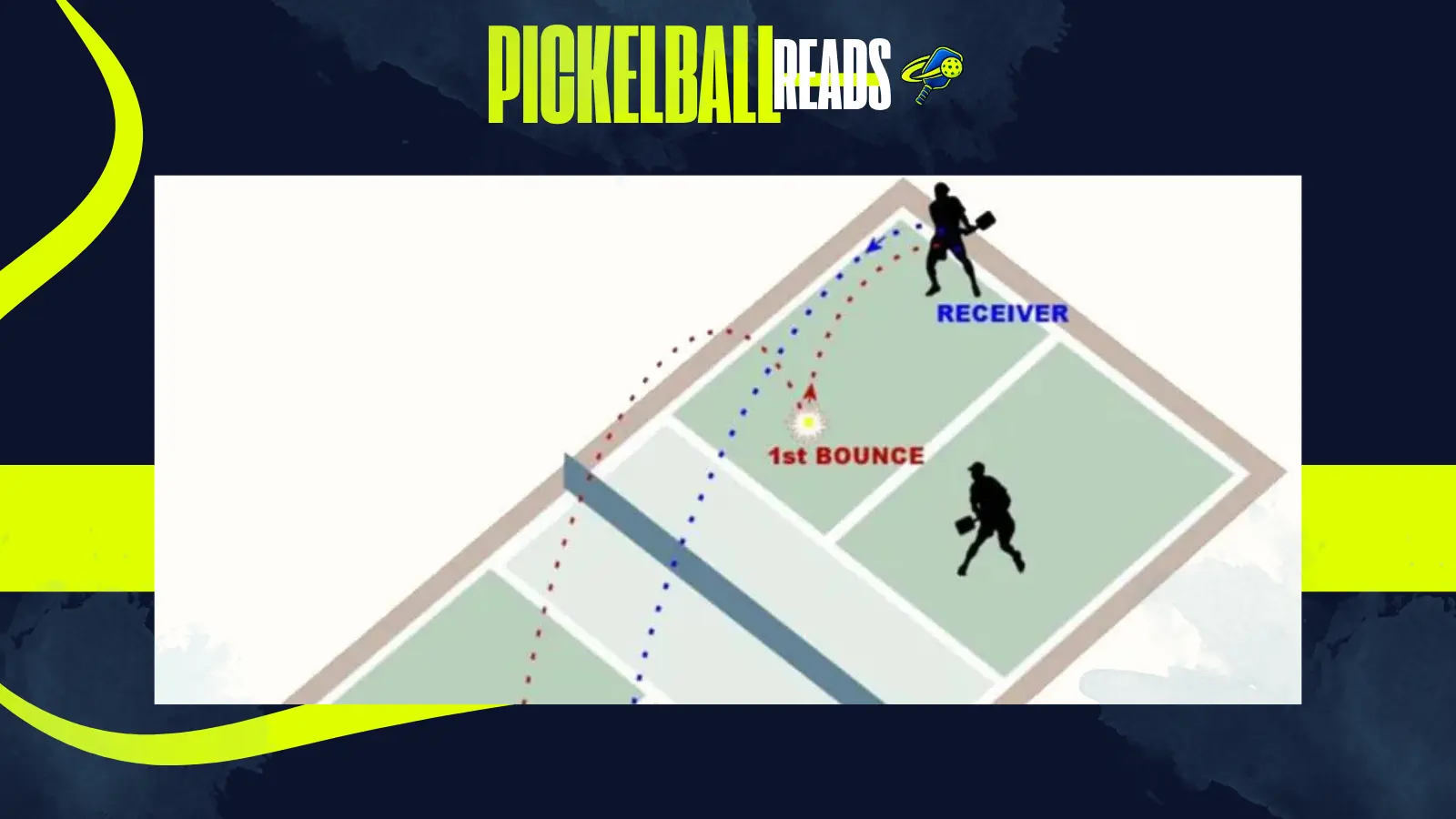
Any fair method can decide first choice of side, service, or receive. A coin toss is one fair method, not the only method.
In doubles, the player on the right serves first. At the start of a new game, the first serving team gets only one server. Hence the opening call, 0-0-2.
The Serve
One attempt. Serve underhand, diagonally, past the kitchen line. Kitchen line: fault. Other lines: in.
Volley serve: clearly upward arc, contact below waist level, not below the navel, paddle head below the highest part of the wrist.
Drop serve: drop, do not toss, let it bounce, then strike it. No volley form rules apply, but it must land past the kitchen line.
Feet: at contact, at least one foot behind the baseline, neither foot touching the court or outside the line extensions.
Net: no let replay. A net serve that lands in is live, in the kitchen or out is a fault.
Service Sequence
In doubles, both players serve, except for the first sequence of a new game. First serve of each side out is from the right. If the serving team scores, the server switches sides, until the serving team faults. Then the partner serves. After the second server faults, the other team serves, also from the right.
In singles, serve from the right on an even score, left on an odd score. In doubles, the same rule sets the first server position. The receiving team does not switch sides during a service turn.
Scoring
Traditional side-out scoring: only the serving team scores. A receiving team fault gives a point to the serving team. A serving team fault loses the serve, or causes a side out after the second server.
Games are normally to 11, win by 2, for example 12-10 after 10-10. Tournament games may be to 15 or 21, also win by 2. Match format varies, a common format is best 2 out of 3 to 11.
Call the score before each serve. Doubles: serving team score, receiving team score, server number, 1 or 2. Singles: server score, then opponent score.
Teams switch ends between games, and mid-game at 6 in a single or deciding game to 11, or at 8 in a game to 15.
Rally scoring is a caveat, not the default. Every rally scores, including the game winning rally, in this provisional 2026 format. It uses a two number call and one server per doubles turn.
The Two-Bounce Rule
The receiving team must let the serve bounce, then the serving team must let the return bounce. That is two bounces, one on each side. After that, both teams may volley, or play off a bounce.
This removes the serve and volley advantage. It does not allow two bounces on one side. A second bounce on one side before the return is a fault.
The Non-Volley Zone
The kitchen, or non-volley zone, is within 7 feet on both sides of the net. Volleying inside it is prohibited, to stop smashes from right at the net. Overheads from outside the zone are allowed.
You may stand in the kitchen when not volleying, and step in for a ball after it bounces. It is a fault if, when volleying, you step on the zone, including the line, or momentum carries you, or anything worn or carried, into the zone, even if the ball is already dead. If you run through the zone, reestablish both feet outside before volleying.
Line Calls
A ball on any line, except the non-volley zone line on a serve, is in, including baseline, sideline, and centerline. A serve on the non-volley zone line is short and a fault. In a rally, a ball on the kitchen line is in.
Faults
A fault stops play. In traditional scoring, a receiving team fault gives a point to the serving team. A serving team fault loses the serve or causes a side out.
A fault occurs when a serve lands outside the receiving court, the ball is hit into the net, the ball is volleyed before a bounce on each side, the ball is hit out of bounds, a ball is volleyed from the kitchen, a ball bounces twice before being struck, a player, clothing, or paddle touches the net or net post in play, a service rule is violated, a ball strikes a player or anything worn or carried, or a ball strikes a permanent object before bouncing.
This is a beginner safe list, not the complete rulebook list.
Wheelchair Rules and Pickleball in Canada
Wheelchair play follows the same rulebook, with adaptations. The chair is part of the body. A player in a wheelchair may let the ball bounce twice, fault only on a third bounce. On a serve, rear wheels must stay behind the baseline and within the sideline and centerline extensions. Front wheels may touch the kitchen on a volley, but rear wheels must be clear to volley.
In Canada, sanctioned play follows the same 2026 Official Rulebook, posted by Pickleball Canada in English and French. There are no separate Canadian serve, scoring, kitchen, or court rules.
Tips for Beginners
These are tips, not rules. Start by volleying from just outside the kitchen, then move back. Aim serves deep, but value consistency first, and move up after the two-bounce rule is complete. For a step by step walkthrough, see how to play pickleball.
Frequently Asked Questions
Can you stand in the kitchen in pickleball?
Yes. You may stand in the kitchen and hit a ball there after it bounces. You may not volley while touching the kitchen or its line, and momentum into the kitchen after a volley is a fault.
What is the two-bounce rule in pickleball?
The receiving team must let the serve bounce, then the serving team must let the return bounce. After those two bounces, one on each side, both teams may volley or play the ball off a bounce.
Can a pickleball serve land on a line?
Yes, on the baseline, sideline, and centerline. No, on the kitchen line. A serve on the kitchen line is short and a fault.
Do you have to win by 2 in pickleball?
Yes, in standard play. Games are normally to 11, win by 2, and tournament games to 15 or 21 are also win by 2. At 10-10, play continues until one side leads by 2.
What is the difference between traditional and rally scoring?
In traditional side-out scoring, only the serving team scores, doubles uses a three number call, and each doubles team normally has two servers per turn. In rally scoring, every rally scores, doubles uses a two number call, and each doubles team has one server per turn. Rally scoring remains provisional in 2026.
Conclusion
Learn the serve, sequence, two-bounce rule, kitchen, and fault list, and you can play without stopping to argue the rules. Confirm scoring and match format before a tournament. For the full text, see the Official USA Pickleball Rulebook.