
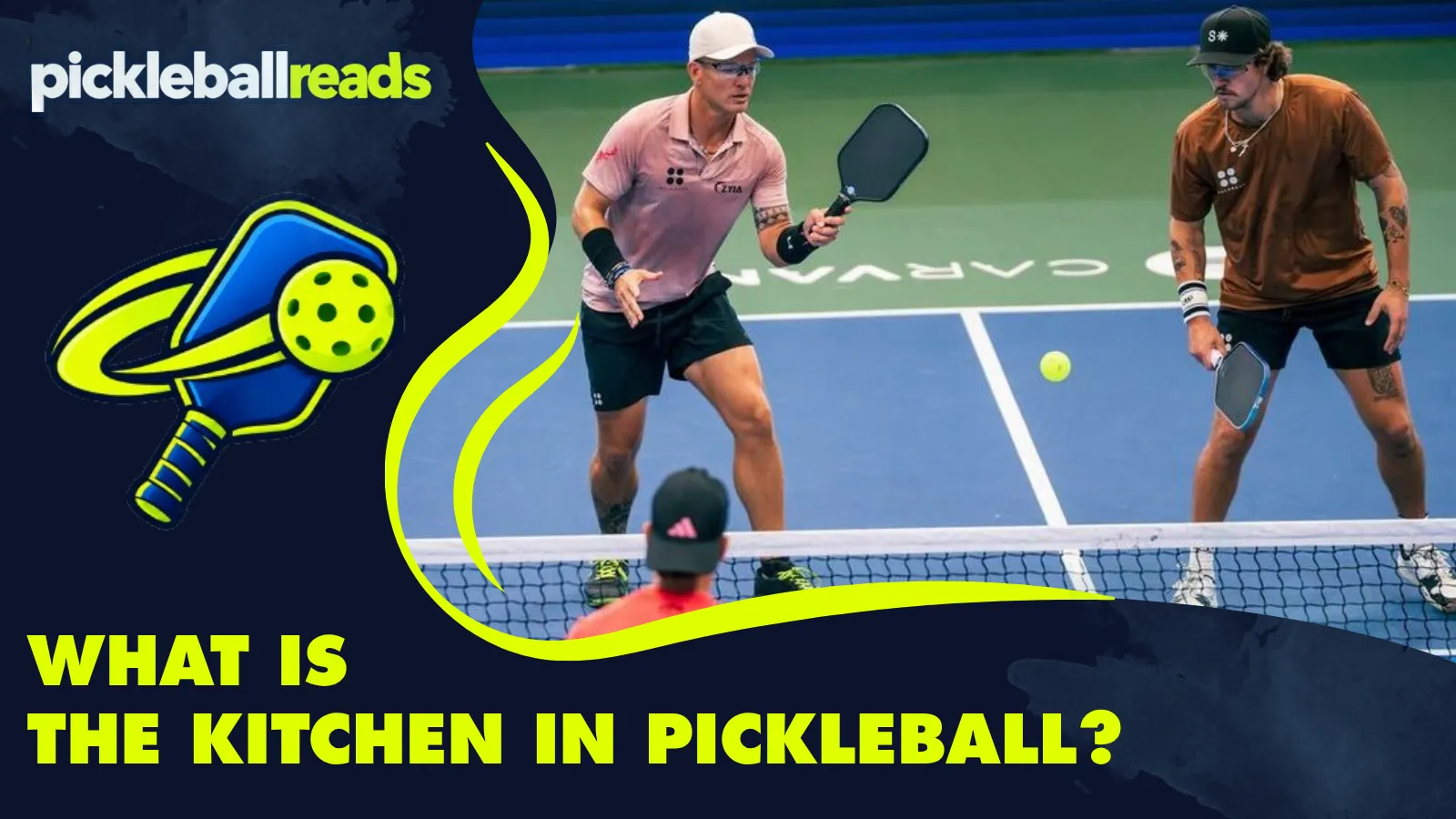
What is the kitchen in pickleball? It is the 7-foot zone on each side of the net where you cannot volley. Its official name is the non-volley zone, usually shortened to NVZ. Players call it the kitchen, and that nickname is now part of everyday court language in the USA and Canada.
The kitchen exists for a simple reason. Without it, a tall or powerful player could stand right at the net and smash almost every ball out of the air. The kitchen forces players to step back to volley, so soft shots, patience, and placement matter as much as power.
What Is the Kitchen?
The kitchen is the 7-foot by 20-foot area on each side of the net. It runs the full width of the court, from sideline to sideline, and its line sits 7 feet from the net on each side. All lines that bound the zone are part of the zone. A toe on the kitchen line counts the same as a foot inside the kitchen.
The zone is two-dimensional and does not extend above the playing surface. You may reach your paddle over the kitchen to volley, as long as your feet and gear stay outside the zone and the volley starts outside it. There is no centerline in the kitchen.
For the full court layout, including the service courts behind the kitchen, see pickleball court dimensions.
The Core Rule: No Volleys in the Kitchen
The core rule is short. You cannot volley while you are in the kitchen. A volley is a strike of the ball before the ball bounces. A shot played after the ball bounces is a groundstroke, and the kitchen ban does not apply to it.
All volleys must be initiated outside the non-volley zone. No part of you, and nothing in contact with you, may touch the zone during the act of volleying. The act of volleying begins when the ball is hit out of the air, and it ends when your movement from the follow-through, which is your momentum, stops.
For the plain language official summary of this rule, see the Essential Pickleball Rules Summary.
What Counts as "In the Kitchen"?
You are in the kitchen if anything in contact with you touches the zone during the act of volleying. That includes your feet, your clothing, your paddle, a hat, a towel, or anything else you are wearing or carrying. It also includes your partner, if your partner is in contact with you and touches the zone.
For example, a toe on the kitchen line, a paddle scraping the kitchen surface, or a hat falling into the kitchen during a volley are all faults, because each item was in contact with you and the contact was caused by the volley.
Can You Ever Step in the Kitchen?
Yes. You can step in the kitchen at any time, except when you are volleying. You can stand in it, walk through it, and play a ball from it after the ball has bounced. This is the point most new players miss, because the name makes the zone sound off limits.
The dink is the classic example. A dink is a soft shot that lands in the opponent kitchen and forces the opponent to let the ball bounce. When you step in to return a dink, you are playing a bounced ball, so you are legal. You may stay in the kitchen after playing that bounced ball. You only run into trouble if you then try to volley without first getting back outside the zone.
Can You Go Into the Kitchen Before the Ball Bounces?
Yes, entering the kitchen before the ball bounces is not itself a fault. The fault comes from what you do next. After you contact the kitchen, you must have both feet contact the playing surface completely outside the kitchen before you volley again. If you volley before both feet are outside, it is a fault.
That rule explains the early entry mistake. You step in early, expecting a soft dink. Your opponent instead drives the ball hard. If you volley that drive while you are still in the kitchen, or before both feet are back outside, it is a fault. If you get both feet outside first and then volley, the volley is legal. Early entry is a risk, not an automatic fault.
Serving and the Kitchen
Serving has its own kitchen rule, and it is strict. The served ball must clear the opponent non-volley zone and land in the correct service court, diagonally opposite your correct position. The serve may touch the net and still be live, as long as it clears the zone and lands in the correct court.
A serve that lands in the kitchen is a fault against the server. A serve that lands on the kitchen line is also a fault, because the line is part of the zone and a serve on that line is short. This is the one exception to the usual line rule. For other shots, a ball on a line is in. For a serve, a ball on the kitchen line is out.
The Momentum Rule
Momentum is the rule that causes the most arguments. Momentum is the property of a body in motion that causes a player to continue in motion after contacting the ball. It ends when the player regains balance and control of their motion, or stops moving toward the non-volley zone.
If your momentum from a volley carries you into the kitchen, it is a fault, even if the ball is already dead. You can hit a clean winner, and still lose the rally if your forward motion then carries you into the zone before you regain balance and control. The same applies if your momentum causes your paddle, hat, or hand to touch the zone, or causes you to contact your partner while your partner is in contact with the zone. Once you have regained balance and control, or stopped moving toward the zone, momentum has ended, and a later unrelated step into the kitchen is not a momentum fault.
The Partner Save and the 2-Becomes-1 Rule
Two informal player terms describe partner contact, and neither term is in the rulebook. The partner save is when your partner grabs you and pulls you back so your momentum does not carry you into the kitchen. That save is legal, but only if neither you nor your partner contacts the kitchen. If your partner is standing in the kitchen and you bump into your partner while your momentum carries you forward, you inherit that contact, and it is a fault. Players call that the 2-becomes-1 rule.
The rulebook version is simpler. When a volleying player, or anything in contact with the volleying player, including the partner, contacts the zone, it is a fault. When momentum causes the volleying player to contact anything, including the partner, that is in contact with the zone, it is also a fault.
Can You Jump and Land in the Kitchen?
Jumping splits into two cases. First, if you jump from outside the kitchen, volley in the air, and land in the kitchen, it is a fault if your momentum carries you there. Landing inside after a volley is a momentum fault, even if the ball is already dead.
Second, if you start inside the kitchen, jump up, volley in the air, and land outside, it is also a fault. After contacting the kitchen, you must have both feet contact the surface completely outside the kitchen before you volley. A jump does not skip that step. Jumping alone, with no volley, is not a fault.
Common Kitchen Faults, With Examples
Most kitchen faults fall into four patterns. First, the toe on the line. You crowd the net, volley a shoulder-high ball, and your front toe is just touching the kitchen line. Because the line is part of the zone, it is a fault, even if the volley itself was clean.
Second, momentum carries you in. You volley from just outside the zone, fly forward, and step into the kitchen after the shot. It is a fault, even if you hit a winner and the ball bounced twice before you stepped in.
Third, the reach-in volley. You step in to play a dink, the next ball floats high, and you punch it out of the air while you are still in the kitchen. It is a fault. You would need to retreat with both feet fully outside the zone before volleying.
Fourth, using the kitchen as a brake. You volley from just outside the zone, then tap the kitchen surface with your paddle or your off hand to steady yourself. Because that contact is caused by volley momentum, it is a fault, even though your feet never entered the zone. The reach-and-fall, where you stretch for a volley and stumble into the kitchen, is also a momentum fault. The paddle drop is a fault if the drop is part of the volley action or its momentum.
Busting the Biggest Kitchen Myths
Three myths cause most kitchen confusion. The first is that the kitchen is lava, and you can never step in it. That is false. You can be in the kitchen any time other than when volleying, and you are expected to step in to play bounced dinks.
The second is the hover rule, the idea that you cannot cross the plane of the kitchen line at all. That is also false. The kitchen is a two-dimensional area on the ground. You may reach your arm and paddle across the line to volley, as long as your feet and gear stay outside the zone and you do not touch the ground inside it.
The third is that you can jump and hit from the kitchen if you land outside. That is false. You must have both feet outside before the volley, not after it.
Other myths, in short form: the line is part of the kitchen; if the ball bounces in the kitchen, you may enter to play it; a paddle or hat touching the kitchen during a volley is a fault; the standard rules apply to recreational play as well as tournament play; anything in contact with you counts, not only your body; and singles players cannot ignore the kitchen, because the rules are the same for singles and doubles.
How Kitchen Rules Shape Strategy
This section is strategy, not a rule. The kitchen changes how points are built, because most balls near the net must be played off the bounce if you are in the zone. That rewards soft hands over pure power.
In doubles, patient dinks force awkward contact from opponents, and low dinks can produce a pop-up you can attack from outside the line. In singles, drops to the kitchen pull opponents forward, while deep serves and returns delay their path to the kitchen line.
The third shot drop, a soft shot from the baseline into the opponent kitchen, gives your team time to advance to the kitchen line. Stacking, where partners switch sides to keep a forehand or backhand in the middle, is a real doubles tactic, but it does not change the kitchen rules.
Advanced Shots: The Erne and the ATP
Erne and ATP are player terms, not rulebook exceptions. Both shots must still satisfy the kitchen rules. They are advanced because they test the edges of those rules, not because they break them.
The Erne is an aggressive move near the sideline. A player moves or jumps completely outside the court boundaries and volleys the ball out of the air right next to the net. It is legal because the volley starts outside the kitchen, from outside the sideline, with no zone contact during the volley, and momentum does not carry the player into the zone. The player must also respect the plane of the net rules.
The ATP, or around the post, is different. When an opponent hits a sharp angled shot that pulls you far off the sideline, you may hit the ball low and completely around the outside of the net post, as long as it lands in the opponent court. It does not allow a ball hit between the net and the post, or under the net, and the ball must entirely cross to your side before you hit it. Kitchen rules still apply.
Adaptive Play: Wheelchair Kitchen Rules
Wheelchair kitchen rules follow the same logic as standing rules, with wheel tests in place of foot tests. The front smaller wheels and the rear stabilizing wheels may contact the kitchen at any time. The large rear wheels are treated like a standing player legs for positioning.
When a large rear wheel, or anything in contact with the volleying player, including the partner, contacts the kitchen while volleying, it is a fault. When momentum causes a large rear wheel to contact anything in contact with the kitchen, even after the ball becomes dead, it is also a fault. After contacting the kitchen, a wheelchair player must have both large rear wheels contact the playing surface completely outside the kitchen before volleying.
Rules Intersections: Let Serves and Line Calls
Two related rules sit next to the kitchen rules. The first is the let serve. The 2026 rulebook does not use a let replay for serves. A serve that clips the net and lands in the correct service court is live, because the serve must clear the kitchen with or without touching the net. A net serve that lands in the kitchen, or on the kitchen line, is still a fault.
The second is line calls near the kitchen. Players are responsible for out calls on their own end of the court, and in doubles either partner may make a line call. Questionable calls must be resolved in favour of the opponent, and any ball that cannot be promptly called out must be considered in. You must not call a ball out unless you can clearly see a space between the line and the ball when it lands.
Who calls a kitchen fault follows the same fair play logic. Players are expected to call faults on themselves or on their partner as soon as the fault is detected. Players may only call kitchen faults and service foot faults on an opponent, and the call must be made before the next serve. If teams disagree, the rally must be replayed. If partners disagree, the call goes to the benefit of their opponents.
Kitchen Rules in Canada
In Canada, sanctioned play follows the same 2026 Official Rulebook. Pickleball Canada adopts the official rulebook endorsed by USA Pickleball and the Global Pickleball Federation, and it posted the 2026 edition in English and French in March 2026. There is no separate Canadian kitchen rule, kitchen size, or kitchen line rule.
For readers in Canada, the numbers are the same, with metres in brackets: the kitchen is 7 feet (2.13 m) deep by 20 feet (6.10 m) wide on each side, on a court that is 20 feet (6.10 m) wide by 44 feet (13.41 m) long. For the Canadian rulebook text, see the Pickleball Canada 2026 Official Rulebook.
Practical Checklist: Avoiding Kitchen Faults in Matches
Use this checklist before and during a match. It is a summary of the verified rules above, not a new set of rules.
Before each rally, picture the kitchen line and give yourself a small buffer behind it.
Split-step as your opponent hits, so you do not drift through contact.
After any volley, freeze, then reset your feet, and do not stumble forward.
If you touched the kitchen, get both feet completely outside before you volley again.
Keep towels, spare balls, and other gear off the court, because momentum contact can cause strange faults.
Communicate on every ball near the kitchen, and call your own fault promptly if you commit one.
If a fault call is disputed between teams, replay the rally, as the rulebook requires.
Quick reference: no volleys while you or your gear touches the kitchen, the line is part of the kitchen, and momentum counts even after the ball is dead.
Frequently Asked Questions
Can you stand in the kitchen in pickleball?
Yes. You can stand in the kitchen at any time, except when you are volleying. The rule bans volleying from the kitchen, not standing in it. You can also hit a ball from the kitchen after it has bounced.
What is a volley in pickleball?
A volley is a strike of the ball before the ball bounces. If the ball bounces first, the shot is played off the bounce, and the kitchen volley ban does not apply to that shot.
Can you volley above the kitchen?
Yes, if your feet and anything in contact with you stay outside the kitchen. The kitchen is two-dimensional and does not extend above the playing surface, so reaching your paddle over the kitchen to volley is legal, as long as the volley starts outside the zone.
Does momentum into the kitchen count if the ball is already dead?
Yes, if the contact is caused by volley momentum. The rulebook states this as an exception: a momentum fault can occur even after the ball becomes dead. The window ends when you regain balance and control, or stop moving toward the kitchen.
Can you jump from the kitchen and volley if you land outside?
No. After contacting the kitchen, you must have both feet contact the playing surface completely outside the kitchen before you volley. Jumping and landing outside after the volley does not meet that test.
Conclusion
What is the kitchen in pickleball? It is a 7-foot by 20-foot zone on each side of the net where volleys are banned, but standing and playing bounced balls are allowed. Learn the core rule, respect momentum, and re-establish both feet outside before you volley again.
For the full game around the kitchen, including serving, scoring, and the two-bounce rule, see pickleball rules.